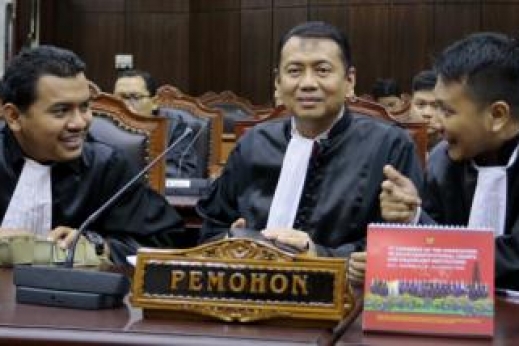
The Petitioner\\'s Legal Counsel was present in the hearing to revise the petition for material judicial review of Law on Mass Organizations (Ormas Law), Tuesday (22/8) at the Plenary Hall of the Constitutional Court Building. Photo by PR/Ifa.
The hearing for the revision of the petition for judicial review of Government Regulation in Lieu of Law No. 2 of 2017 on Mass Organizations (Perppu Ormas) was held by the Constitutional Court on Tuesday (22/8) afternoon. Petitioners of the case Number 50/PUU-XV/2017 are several Islamic organizations, among them the Dewan Dakwah Islamiyah Indonesia, Yayasan Forum Silaturahmi Antar Pengajian Indonesia, and the Indonesian Islamic Student Association.
The Petitioners, represented by their legal counsel Rangga Lukita Desnata, delivered a number of revisions to the petition, especially in the formal review section. "In principle, our revisions concern the formal review section. There are no additional titles on the matters we take issue with about Perppu No. 2 of 2017, but there are additional arguments and reinforcement of arguments for the formal review, Your Honor," Rangga told the Panel of Justices led by Chief Justice of the Constitutional Court, Arief Hidayat.
The Petitioners also revised the articles petitioned for material review. "As for the material review, the articles that we petitioned in the first hearing remain the same, Your Honor, namely Article 1 number 6 to 21 and Article 59. Specifically for Article 59 that we reviewed the other day was the enacting terms, the articles. Today we review the elucidation, in the phrase \\'or other doctrines\\', Your Honor. Also, Article 62 paragraph (3), as per the initial petition. Article 80A remains, Article 82A paragraph (1) and paragraph (2) remain, as per the initial petition, Your Honor," said Rangga.
In the preliminary hearing, the Petitioners, represented by Rangga Lukita, stated that their constitutional rights were violated by the enactment of the Perppu. Therefore, the stipulation of Perppu which a unity with the Ormas Law, was deemed not in accordance with the procedures prescribed in Article 12 of the 1945 Constitution and there was no ‘state of emergency’ as stipulated in Article 22 paragraph (1) of the 1945 Constitution.
According to the Petitioners, the procedure of stipulating the Perppu should be preceded by a declaration of state of emergency by the President, of which terms and consequences are stipulated by the law. In the absence of such declaration and criteria, it would be equal to giving the President the opportunity to abuse power. In their petition, the Petitioners considered that formally the Ormas Law had violated the procedure of issuing a Perppu.
In addition, the Petitioners also questioned the material substance of Article59 Paragraph (4) letter c and Article 82A Paragraph (1) and (2) of Ormas Law which was considered very broad, might have multiple interpretations, and threatening the Petitioner\\'s constitutional rights to receive a fair guarantee, protection, and legal certainty. Therefore, in his petitum, the Petitioners requested that the Court declare that the enactment of the Ormas Law contrary to the Constitution and not legally binding.
(Nano Tresna Arfana/lul/Yuniar Widiastuti)
Tuesday, August 22, 2017 | 18:54 WIB 181