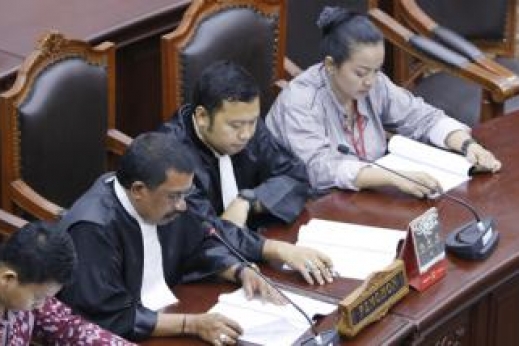
Applicant’s Attorney Fahmi Bachmid delivered petition points in revision session of Case No. 80/PUU-XIV/2016 on Monday (17/10) in Plenary Room, the Constitutional Court Building. Photo PR/Ifa
Ira Hartini Natapradja Hamel, mother of dual-citizenship flag hoisting troop member (Paskibraka) Gloria Natapradja, revised petition concerning Act of Citizenship (UU Kewarganegaraan). Applicant’s Attorney Fahmi Bachmid delivered revision points in revision session of Case No. 80/PUU-XIV/2016 on Monday (17/10)
The Applicant said she has revised petition in accordance with Justice Panel input. According to the Applicant, child who born from intermarriage, born prior to the enactment of Act of Citizenship, and under 18 year or yet married should not be restricted in citizenship registration, because the minor’s citizenship status has been regulated in Article 6 (1) Act of Citizenship.
The Article stated, “As referred in Article 4 letter c, letter d, letter h, letter I and Article 5, dual-citizenship child should choose one of the citizenships and declare it when the child has 18 years old or has married,” (”Sebagaimana dimaksud dalam Pasal 4 huruf c, huruf d, huruf h, huruf i, dan Pasal 5 berakibat anak berkewarganegaraan ganda setelah berusia 18 tahun atau sudah kawin anak tersebut harus menyatakan memilih salah satu kewarganegaraannya.”).
“Obligation to register (child’s citizenship, ed.) within 4 years since the enactment of Act of Citizenship causes legal uncertainty,” said Bachmid representing the Applicant in the session led by Chief Justice Arief Hidayat.
The Applicant argued her constitutional rights have been harmed by Article 41 Act of Citizenship. The Article stated, “Child who born as referred in Article 4 letter c, letter d, leter h, and letter l, and child who recognized or legally adopted as referred in Article 5 and prior to this Act enacted, as well as yet 18 years old or unmarried, grants Indonesian citizenship based on this Act by registering to Minister via Indonesian Official or Representative not later than 4 years since this Act enacted,” (“Anak yang lahir sebagaimana dimaksud dalam Pasal 4 huruf c, huruf d, huruf h, huruf l dan anak yang diakui atau diangkat secara sah sebagaimana dimaksud dalam Pasal 5 sebelum Undang-Undang ini diundangkan dan belum berusia 18 (delapan belas) tahun atau belum kawin memperoleh Kewarganegaraan Republik Indonesia berdasarkan Undang-Undang ini dengan mendaftarkan diri kepada Menteri melalui Pejabat atau Perwakilan Republik Indonesia paling lambat 4 (empat) tahun setelah Undang-Undang ini diundangkan”).
The Applicant assessed that her child Gloria who born from an intermarriage has been discriminated by the Article. As known, Gloria is 16 years old and yet married, so she didn’t fulfill administrative requirements to choose citizenship either her mother’s Indonesian citizenship or her father’s French citizenship. Such condition made her often questioned during public service, particularly in administrative service and service that relates to citizenship.
The Applicant assessed that Article 41 contrary to Article 28D (1) and (4) the 1945 Constitution because the obligation to register citizenship for child under 18 years who born from intermarriage and raised up in Indonesia is borne to Applicant’s family. Whereas, Bachmid added, Article 28D (1) the 1945 Constitution indeed bestows obligation in implementation of recognition, guarantee, protection, equality before the law, including right to citizenship, to the State. The Applicant argued the Article causes administrative difficulty for her. She argued the difficulty is contrary to constitutional provision which the State obliges to give ease to citizen as stated in Article 28H (2) the 1945 Constitution. (Lulu Anjarsari/lul/Prasetyo Adi N)
Monday, October 17, 2016 | 18:14 WIB 236