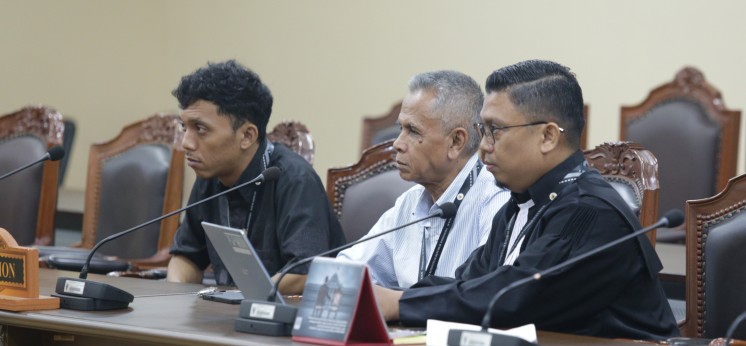
Petitioner and his legal counsel attending the Preliminary Hearing of Case No. 177/PUU-XXIV/2026 on the material review of Law No. 1 of 2004 on the State Treasury on Monday (8/6). Photo by MKRI/Bay.
Jakarta (MKRI) – The Constitutional Court (MK) held a preliminary hearing of Article 40 paragraphs (1) and (2) of Law No. 1 of 2004 on State Treasury (State Treasury Law). Petition No. 177/PUU-XXIV/2026 was filed by Kusdiana, a retired civil servant from the Ministry of Foreign Affairs. The preliminary hearing was held on Monday, June 8.
Article 40 paragraph (1) of the State Treasury Law reads, “Claims for debts owed by the state or local government expire five (5) years after the debt becomes due, unless otherwise provided by law”. Article 40 paragraph (2) of the law states that “The statute of limitations referred to in paragraph (1) is suspended if ‘the creditor files a claim with the state or local government before the expiration of the statute of limitations'”.
Through legal counsel Viktor Santoso Tandiasa, Kusdiana revealed that during his overseas assignment, he did not receive a base salary because it was considered to be included in her housing allowance. “During that overseas assignment, the petitioner never received a base salary due to a circular from the Ministry of Foreign Affairs stating, in essence, that the base salary in Indonesia was not provided because it was already considered part of the housing allowance,” said Viktor.
According to Viktor, this matter has been ruled by the Constitutional Court in Decision No. 184/PUU-XXII/2024. In its legal considerations, the Court held that base salary is not state debt with an expiration date.
“In the decision, the Court rejected the Petitioners’ petition but stated that the issue concerning the base salary is formally not considered as state debt with an expiration date and ordered the government to resolve the issue; however, despite there is a moral empasis from the Court, there is no rigid constitutional mandate, hence, the Ministry of Foreign Affairs claimed that this issue has been expired,” Viktor said.
Moreover, the Petitioner stated that the implementation of the expiration provisions as stipulated in both norms being tested causes the Petitioner to suffer constitutional losses. Moreover, the arguments presented in this case differ from the previous Court decision that addressed the same norms.
The Petitioner believed that the implementation of the expiration of civil servants’ base salaries constitutes a form of legal uncertainty that taints the Constitution. “The provision in question is inconsistent with the right to fair and adequate compensation in employment relationships under Article 28D(2) of the 1945 Constitution of the Republic of Indonesia. The base salary is not merely an administrative component but a minimum livelihood right and recognition of a civil servant’s official status,” Viktor said.
Therefore, in the petitum, the Petitioner requests that the Court declare Article 40 paragraph (1) of the State Treasury Law, as interpreted by the Constitutional Court in Decision No. 15/PUU-XIV/2016, to be inconsistent with the 1945 Constitution of the Republic of Indonesia and to have no binding legal force insofar as it is interpreted “applied to pension benefits, old-age benefits, and the income rights of civil servants, in this case, Civil Servants and Retired Civil Servants, in the form of unpaid base salaries during their assignment to Indonesian diplomatic missions abroad prior to January 1, 2013.”
Advisory Session
Justice M. Guntur Hamzah provided several pieces of advice, including strengthening the argument on the causal relationship between the norms being tested and the constitutional harm. “It is also necessary to strengthen the arguments and examine the causal relationship, or “causal verband”, with the subject of the review, especially since the Constitutional Court has already interpreted the subject of the review. In that context, it is also necessary to clarify whether the Petitioner still has legal standing, or at least to explain this clearly in the petition,” said Justice Guntur.
Justice Daniel Yusmic P. Foekh, in his advice, asked the Petitioner to strengthen the explanation of the Petitioner’s legal standing. “Whether or not there is indeed a constitutional harm, the Petitioner should try to explain the causal relationship between the alleged harm and the enforcement of the provision in question,” said Justice Daniel.
Lastly, Chief Justice Suhartoyo, who presided over the hearing, advised the Petitioner to further elaborate on the factual basis or grounds for the petition. “If today’s request to apply this to cases filed before January 2013 is too narrow, what about cases that expire after that? They would not be covered, because the provision would no longer be general in scope,” explained Chief Justice Suhartoyo.
Before adjourning, Chief Justice Suhartoyo stated that the Petitioner may submit a revised petition on Monday, June 22, 2026, at 12.00 noon Western Indonesian Time, at the latest. The revision can be submitted once, either in person or online.
Case tracking: Petition No. 177/PUU-XXIV/2026
Author: Ilham W.M.
Editor: Lulu Anjarsari P.
PR: Fauzan Febriyan
Translator: Rizky Kurnia Chaesario
Disclaimer: The original version of the news is in Indonesian. In case of any differences between the English and the Indonesian versions, the Indonesian version will prevail
Monday, June 08, 2026 | 20:12 WIB 16